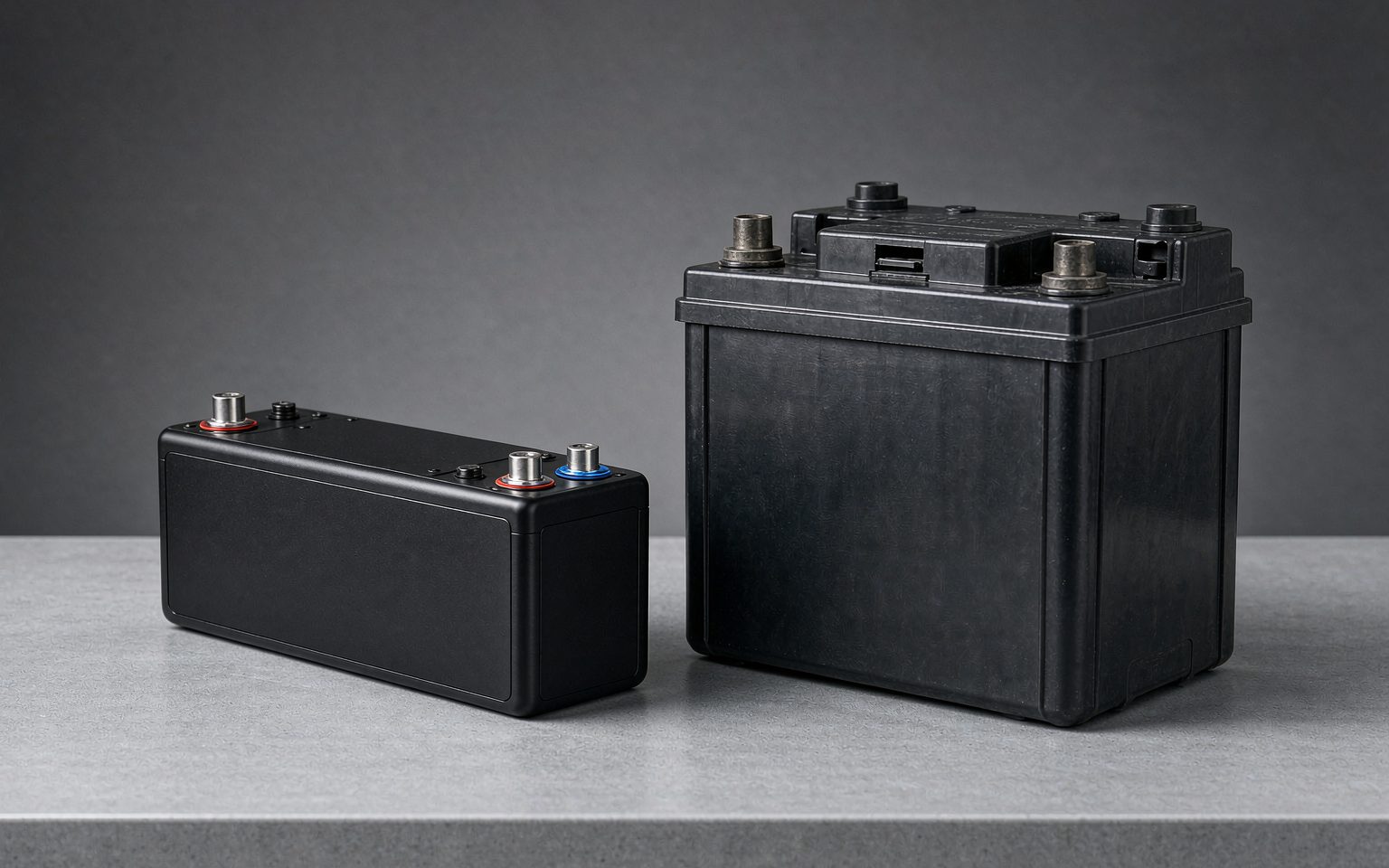
Deep cycle batteries still come in three main chemistries: AGM, gel and LiFePO4. If you are building or upgrading an RV, boat, solar storage or off-grid system in 2026, here is an honest, numbers-first comparison — including the cases where lead-acid still makes sense.
For most deep-cycle applications, LiFePO4 wins on total cost of ownership. It delivers 2–3× the usable capacity per rated Ah, lasts 4–8× longer, and weighs about half. AGM remains reasonable only where upfront budget is tight or in extreme engine-bay heat.
Lead-acid batteries should not be discharged below 50% if you want them to last. A “100Ah” AGM gives you ~50 usable Ah. LiFePO4 tolerates 80–100% depth of discharge daily: a “100Ah” lithium pack delivers 80–100 usable Ah. To match one 314Ah LiFePO4 battery, you would need roughly five 100Ah AGM batteries.
| AGM | Gel | LiFePO4 | |
|---|---|---|---|
| Cycles @50% DOD | 400–600 | 500–800 | 3,000–6,000 |
| Weight (100Ah class) | ~30 kg | ~32 kg | ~11 kg |
| Charge time | 6–8 h | 8–12 h | 2–3 h |
| Maintenance | None | None | None |
| Cost per usable Ah-cycle | High | High | Lowest |
LiFePO4 needs a charger profile of ~14.2–14.6V with no equalization stage. Most modern MPPT solar controllers, inverter-chargers and DC-DC chargers have a lithium mode — just switch it on. Pairing lithium with solar is where the chemistry shines: fast absorption means full recharge even on short sunny days.
If your system cycles daily — RV, marine house bank, off-grid cabin, solar storage — LiFePO4 pays for itself within 2–3 years and keeps running for a decade. Compare real capacities in our catalog, including 12.8V 942Ah heavy-duty packs and wall-mounted 25.6V storage for fixed installations. Need a custom configuration? Talk to our engineering team — OEM and ODM orders are welcome.
Fill in the form and our sales team will reply with a quote.